

Welcome to the sixth edition of AI for Animals! This newsletter brings you the latest news around AI’s potential impacts for animals. While the main focus is on biological animals, we also include content relevant to digital minds.
Each edition also gives a brief overview of a specific topic relating to AI and animals. In this edition, we explore how humans could use AI to help animals living in the wild.
If you think our work to build the field of AI and animal protection is important, please consider supporting us with a donation. All donations up to $10,500 will be generously doubled by Mobius. This is an exciting time to be supporting AI for Animals, as Arturs Kanepajs has just joined us to work on the creation of an animal ethics benchmark for Large Language Models. He will join founder Constance Li and our ever-growing volunteer network to accelerate AI for Animals’ field-building work, including: identifying practical solutions to incorporate animals’ interests into AI models; advising on the inclusion of animals in AI governance; organizing conferences, meetups, and other events; and building partnerships between the AI and animal welfare communities. Support from generous donors is crucial to making this happen.
We’d love to hear your questions or feedback! Just email us at hello@aiforanimals.org. You can subscribe to this newsletter here.
Thanks to Allison Agnello, Madeleine Archer, Constance Li, and Aditya S.K. for their contributions to this month’s edition!
Max Taylor
Index
How can AI help wild animals?

It’s basically impossible to fathom the number of animals living in the wild. Just counting birds, mammals, reptiles, amphibians, and fishes, there are over one hundred thousand non-human animals for every one human being. Once you extend this to crustaceans, insects, and arachnids, that number shoots up to over a billion non-human animals per person.
The fact that these animals live in the wild, rather than in controlled human environments, doesn’t mean we should just leave them to their own devices. Living in the wild can be brutal. Humans have a duty to do what we can to alleviate that brutality, both because we’re the only known species with the ability and understanding to do so, and because we exacerbate the brutality through our carbon emissions, urban development, and environmental destruction.
A frequent argument against efforts to help wild animals is the daunting complexity of the task. Where do we even begin? While they’re still in their early stages, AI applications are starting to yield some potential solutions.
A relatively straightforward place to start is addressing problems caused directly by humans. Each year, road networks kill hundreds of millions of animals in the U.S. alone. A range of AI applications could drastically reduce that number. AI-powered dash cams and thermal sensors can give drivers advance warning of animals on the road. AI-powered deterrent systems can detect approaching deer and warn them away from rail routes using audible and visual alarms. AI-assisted drones can map wild animal movements and identify busy animal crossing points, which can then be made safer through appropriate signage, construction of animal walkways, or integration into drivers’ navigation systems. Self-driving cars could also do a much better job of avoiding animals than human-driven ones (though it’s debatable to what extent their algorithms will prioritize animal wellbeing).
Similar tools can deter animals from wind turbines (which will be a big relief for Donald Trump). Each year, hundreds of thousands of birds and bats are killed by turbines in North America alone. Systems like IdentiFlight can detect birds nearby and either deter the birds or temporarily pause the turbine’s blades. While significant, this technology could be much more impactful if used to address window collisions, which kill an estimated one billion birds each year in the U.S. (While possible in principle, such applications are so far relatively unexplored.)
Mass deaths in wildfires are another avoidable catastrophe. Australia's 2019-2020 bushfire season impacted an estimated 3 billion animals. Brazil’s 2020 Pantanal fires killed 17 million. Despite the warming climate, such fires could be less destructive in the future thanks to technology such as the Australian Kanyini satellite, which lifted off in August. This tiny satellite used advanced AI-powered image processing to detect fires from space 500 times faster than traditional on-ground image processing. Just a few weeks ago, Google helped to launch FireSat, a constellation of satellites designed to detect wildfires as small as 5 by 5 meters. While such initiatives are driven primarily by economic, environmental, and human health interests, the benefits to wild animals could also be huge.
AI tools are also being used to ease human-animal conflicts. The Indian Statistical Institute has developed an AI-powered system that detects leopards likely to stray into human territory and scares them away with a mix of lights and sounds. The TrailGuard AI camera-alert system alerts park rangers about roaming tigers, who can then warn local communities via WhatsApp. WildEyes AI fulfills a similar function for elephants, helping to prevent crop and property damage. Such applications could help transition to a society where humans and animals co-exist, rather than living in fear of one another.
However, AI also raises concerns. The Cacophony Project is testing traps that use AI to lure and kill specific predators. While they are doing this to protect native birds, there seems to be no consideration of the ethical drawbacks of such a device, and it’s worrying to imagine such tech becoming widely accessible in the near future. (The company Backyard Brains sells various devices that, while not powered by AI, illustrate how technology can easily be used to trivial and exploitative ends. For example, their RoboRoach bundle – ‘the world's first commercially available cyborg!’ – allows you to control a cockroach’s movements by surgically attaching electrodes to its antennae.) Rentokil, the world’s largest ‘pest control’ group, plans to use AI-assisted facial recognition to more efficiently exterminate rats, thereby capitalizing on expected rat population booms in Asia. In their own words, ‘Let’s keep pushing the boundaries of pest control’! These kinds of applications could increasingly facilitate, and sanitize, the slaughter of wild animals.
AI also presents fewer tangible solutions to the most systemic sources of wild animal suffering, like starvation and disease. However, some promising suggestions have been put forward. The Kanyini satellite mentioned above demonstrates the impressive image processing capabilities of AI drones. In principle, such drones could be used to administer contraceptives as an ethical way to address overpopulation. They could monitor animals’ health (even to the level of their genetics, hormones, and microbiomes) and administer the necessary vaccines. They could observe animals to assess their levels of wellbeing, and, in cases of emergency, nurse, feed, or euthanize them. Advanced AI systems could also suggest strategies to tackle wild animal suffering that we currently lack the knowledge and insights to come up with, and could be used to model interactions between species to help researchers simulate the likely knock-on effects of wild animal welfare interventions.
None of this is to say that AI will make it easy to help wild animals. Successful, large-scale interventions that address the root causes of wild animals’ suffering will probably remain extremely complex to design and implement, especially when accounting for seemingly inevitable sources of suffering such as predation. And while these technologies are becoming increasingly affordable, they’re still currently too expensive for widespread deployment. Plus there’s the fundamental problem that, for now, people just tend not to care that much about the individual wellbeing of wild animals: even among animal advocates, the predominant view is still that we should just leave them be.
This is why organizations such as Wild Animal Initiative, which seeks to establish a robust research community working on fundamental questions around wild animal welfare science, are so critical. But by facilitating tangible projects to address smaller-scale problems, AI applications could still help a great many animals while also bringing much-needed visibility and optimism to the field of wild animal advocacy. For an issue impacting so many lives but receiving so little attention, that kind of positive engagement could be highly beneficial in itself.
📚 Resources
For more information on AI and wild animals, check out:
Harm to Nonhuman Animals from AI: a Systematic Account and Framework (Simon Coghlan & Christine Parker, Philosophy & Technology)
AI ethics: the case for including animals (Peter Singer & Yip Fai Tse, AI & Ethics)
Using artificial intelligence (machine vision) to increase the effectiveness of human-wildlife conflict mitigations could benefit Wild Animal Welfare (Tapinder Sidhu, Rethink Priorities)
The Hive Community Slack has several channels dedicated to discussion of AI and animals, including #c-ai-discussion for broad discussions and #s-ai-coalition for project collaboration.
If you want to dig deeper, the aiforanimals.org website has a list of relevant articles, papers, and other materials giving an overview of the AI and animals space.
🌏 Opportunities
Free in-person tickets are now available for the AI for Good Global Summit in Geneva, Switzerland (July 8–11, 2025). Tickets for watching online (also free) will be made available in early 2025.
Tickets are still available for the AI for Animals 2025 Conference in Berkeley, California (March 1–2, 2025). Topics will include the future of animal agriculture, interspecies communication, sentience research, increasing animal consideration in frontier AI models, and more. Some confirmed attendees include Jeff Sebo (Director of the NYU Center for Mind, Ethics, and Policy), Peter Singer (Philosopher, attending virtually), Christopher Berry (Executive Director of the Nonhuman Rights Project), and Jacob Shwartz-Lucas (Director of The Animal Pain Research Institute).
🚨 Updates
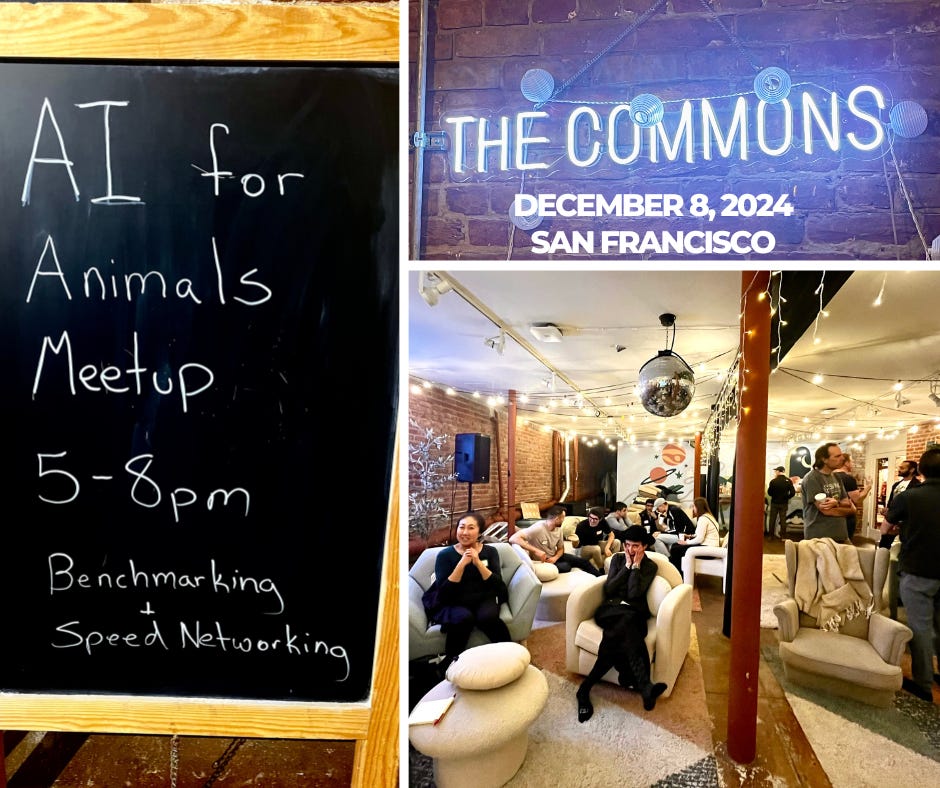
December AI for Animals Meetup: Our monthly meetup in San Francisco resumed after a short hiatus. This meetup was held in a new location at The Commons SF, which supplied us with a beautiful venue space for free. This was a more interactive workshop where attendees participated in evaluating Gemini, GPT, and Claude for animal consideration and speciesism. We found that Claude 3 Opus was the only model willing to apply ethical consistency between different species (dogs vs chickens), with general agreement that Gemini performed the worst. This mirrors our current project to develop a robust benchmark evaluation for Large Language Models at AI for Animals.
🗞️ News & Research
🗣️ Understanding animals
I’ve seen the new AI collar that lets your dog talk, and it’s as wild as it sounds (TechRadar)
Personifi AI has developed the Shazam Band, an AI-powered collar that supposedly allows pets to "talk" to their owners using pre-recorded voices and sensors that interpret the animal's movements and behaviors.
Book Review: How Much Can Animals Really Communicate? (Undark)
In "Why Animals Talk," Cambridge zoologist Arik Kershenbaum argues that instead of focusing on what animals are saying, we should focus on why they communicate, as animal communication is fundamentally tied to evolutionary survival strategies rather than human concepts of language. The book examines communication patterns across various species (including wolves, dolphins, gibbons, and parrots) while cautioning against anthropomorphizing animal communication or expecting them to communicate like humans do, ultimately concluding that while animals can convey complex ideas, they don't combine communication abilities with the same "explosive effect" as humans do.
Soundboard-trained dogs produce non-accidental, non-random and non-imitative two-button combinations (Nature)
A study analyzing data from 152 soundboard-trained dogs found that their button presses were non-random, non-accidental, and not merely imitations of their owners' presses, suggesting deliberate use of the communication devices. At the population level, certain two-button concept combinations appeared more frequently than expected by chance, indicating that dogs were differentiating between buttons and potentially associating different meanings with different buttons, though there was considerable variation between individual dogs in how consistently they used the soundboards.
[Podcast] What Can Birdsong Teach Us About Human Language? (Quanta Magazine)
The podcast discusses how brain research suggests that certain animals, particularly some birds and mammals, share neural circuitry related to language with humans, despite evolving these abilities independently. Through studying vocal learning in birds and other species, scientists are gaining insights into the biological and developmental origins of language, including the discovery that vocal learning is connected to motor pathways in the brain and that only vocal-learning species can learn to dance to rhythmic beats.
🐔 Chicken farming
Farmers tap IoT and AI to increase chicken health and egg yield (Computer Weekly)
A new project called Flockwise, backed by the UK Government, is using ‘Internet of Things’ sensors and AI to monitor and improve the health and welfare of laying hens while increasing egg production efficiency. The system combines sensor technology to monitor factors like temperature, humidity, and air quality with AI analysis to help farmers make better decisions about flock management, potentially leading to £40,000-£110,000 in gains per flock and 1.7 billion more eggs being produced in the UK.
TARGAN brings AI-driven WingScan system to the European market (The Poultry Site)
TARGAN has introduced WingScan, an AI-powered automated system for determining the sex of chicks, to the European market through a contract with a Polish poultry producer. The system can process up to 160,000 chicks per hour with 98% accuracy, allowing producers to implement gender-specific rearing strategies that improve efficiency throughout the production chain.
🐮 Cow farming
Precision livestock technology for disease detection in dairy calves (Ohio Country Journal)
Ohio State researchers are evaluating new precision livestock technologies that use AI and sensors to monitor dairy calf health automatically, rather than relying solely on human observation. The systems combine data from automated feeding systems, activity monitors, and temperature sensors to detect early signs of illness up to three days before visible symptoms appear, though the effectiveness varies based on housing conditions and feeding practices.
🐷 Pig farming
Researchers turn to AI to optimize hog selling (National Hog Farmer)
Researchers have developed an AI model that helps pig farmers decide the optimal time to sell their pigs, recovering about 22% of profits typically lost through traditional decision-making methods. The AI analyzes multiple factors like animal weights, pork prices, feed costs, and contract obligations to make better selling decisions than farmers who usually focus on immediate profits rather than long-term gains.
🐟 Aquaculture and fishing
AI to combat illegal fishing and enhance vessel tracking (The National Fisherman)
Researchers have published a study showing how AI can help combat illegal fishing by processing data from multiple surveillance sources, including satellites, drones, underwater hydrophones, and even seabirds fitted with radar detectors, to track vessel movements and identify suspicious fishing activities.
To compete globally, Europe’s seafood farmers may get boost from AI research (KTH Royal Institute of Technology)
KTH Royal Institute of Technology is developing AI-powered solutions to help European seafood farmers compete globally, including underwater drones adapted for cold Nordic waters that can monitor seaweed beds and fish farms. The technology aims to reduce operational costs by replacing expensive manual labor with automated systems, such as AI-enabled drones that navigate submerged ropes and smart feeding systems that listen to fish eating patterns.
Precision Aquaculture - Global Strategic Business Report (Research and Markets)
The market for precision aquaculture is currently about $675M and expected to more than double to $1.6B by 2030, growing about 13% per year.
🐑 Animal farming: General
Scientists teach AI to recognise when a goat is upset (The Independent)
Scientists have developed an AI system that can recognize when goats are in distress by analyzing video footage of their faces, supposedly achieving 62-80% accuracy in identifying goats experiencing pain. According to the researchers, this technology could not only improve animal welfare and farm productivity but could also potentially help in caring for children and other non-verbal patients who have difficulty communicating their discomfort.
Alliance Group launches AI meat quality insights for farmers (Farmers Weekly)
Alliance Group has implemented artificial intelligence-powered MEQ (Meat Eating Quality) technology across its plant network, using probes that analyze intramuscular fat in lamb and marbling in beef to provide real-time quality insights to farmers. Through a bespoke dashboard, farmer-shareholders can access this data to make informed decisions about breeding, feeding, and livestock management, while the company aims to ensure premium meat quality and enhance consumer experience.
🐠 Wild animals
Conservationists turn to AI in battle to save red squirrels (BBC)
Conservationists are testing an AI tool called Squirrel Agent that can distinguish between red and grey squirrels with 97% accuracy, allowing it to control access to feeders - providing food only to endangered red squirrels while directing grey squirrels to feeders containing contraceptive paste. The system, which is being tested with five wildlife charities, can identify individual squirrels by their unique whisker patterns and could be "an absolute game changer" in protecting Britain's endangered red squirrel population.
FAU Engineers Win NSF Grant for Unique School of AI Bio-Robotic Fish (Florida Atlantic University)
Florida Atlantic University engineers have received an $800,000 grant to develop a school of AI-powered robotic fish that can navigate and communicate underwater while monitoring sensitive marine environments like coral reefs. The project combines bio-inspired propulsion that mimics fish movement with AI and underwater wireless networking, creating a system of three robotic fish that can coordinate their movements and share data in real-time, potentially revolutionizing how we explore and monitor underwater ecosystems that are currently difficult or impossible to study.
Vultures and AI as death detectors: A high-tech approach for wildlife research and conservation (Phys.org)
Scientists from the GAIA Initiative have developed AI algorithms that can analyze data from tagged vultures to detect and locate animal carcasses across vast landscapes with 92% accuracy, creating an early warning system for environmental changes and wildlife deaths. The system combines vultures' natural scavenging abilities with AI-powered tracking devices that monitor their behavior patterns and movements, helping researchers quickly identify potential problems like disease outbreaks, droughts, or illegal wildlife killing while also advancing vulture conservation efforts.
Disrupting wildlife trade with an advanced AI solution (IFAW)
IFAW and Baidu have launched AI Guardian of Endangered Species 2.0, an artificial intelligence system that can identify 34 commonly traded species of animals and their products on online platforms with 86% accuracy, helping to combat illegal wildlife trade. The upgraded system, which has already helped detect over 21,000 images and remove nearly 8,000 illegal postings, will be made available to enforcement agencies and civil society organizations in Southeast Asia before expanding to other regions.
🍔 Alternative proteins
Project Proposal: AI-Powered Experiment Optimization Tool for Alt Protein Development (Noa Weiss)
Coalition member Noa Weiss is a Machine Learning consultant with years of experience in the alt protein industry. She is looking for $50k of funding to develop an open-source tool to optimize selection of R&D experiments. See proposal for details.
Can AI improve plant-based meats? (Stanford Report)
Stanford engineers are using a combination of mechanical testing and machine learning to analyze and improve the texture of plant-based meats, with their new approach showing that some plant-based products already successfully mimic the texture of animal meats they're trying to replicate. The team's three-dimensional testing method, which measures how foods respond to pulling, pushing, and shearing forces (mimicking chewing), combined with AI analysis produces results that closely match human taste testers' evaluations, potentially accelerating the development of more convincing meat alternatives. The full study is here.
Jeff Bezos wants AI to design your Thanksgiving turkey (Heated)
At the UN climate summit, Andrew Steer, head of the Bezos Earth Fund, announced that AI technology can "help design tastier alternative proteins" as part of Jeff Bezos's $100 million commitment to developing sustainable meat substitutes to fight climate change. You can watch the full video here.
UK Startup Develops AI Software to Help Alt-Protein Industry Scale Up Faster & Lower Costs (Green Queen)
New Wave Biotech has created an AI tool that helps alt-protein companies test and optimize their production processes virtually, cutting what typically takes months down to just hours. Instead of spending tens of thousands on real-world trials, companies can now run unlimited simulations for about $100 per month to figure out the best way to scale up their production.
Shiru raises $16m series B to expand AI-powered ingredient discovery platform (AgFunder News)
Shiru has raised $16 million in Series B funding to expand its AI-powered platform ProteinDiscovery.ai, which helps identify and develop new protein ingredients by searching through a database of over 33 million molecules. The company's founder and CEO Dr. Jasmin Hume explains that their technology can help customers find sustainable protein alternatives and reduce development timelines, with applications ranging from food ingredients like their OleoPro fat alternative to skincare ingredients and biopesticides. For more information, here’s another interview with Jasmin Hume.
World Animal Protection Launches Free, AI-Powered Cultivated Meat Chatbot for All Your Questions (Vegconomist)
World Animal Protection and PubTrawlr have launched the Cultivator, the first-ever AI-powered chatbot designed to answer questions and provide information about cultivated meat technology to make it more accessible to consumers. The initiative aims to increase public awareness and acceptance of cultivated meat as a sustainable, slaughter-free alternative to traditional meat production.
AI-Powered Protein Engineering Heightened by Cradle Bio's $73M Series B (Synbio Beta)
Cradle Bio has raised $73M to expand its technology that uses AI to design and modify proteins more quickly than traditional lab methods, claiming to reduce development time by 1.2x to 12x. The company combines actual lab testing with AI modeling to improve protein engineering for uses in medicine, agriculture, and chemicals.
How Mushrooms Can Turn Food Waste Into Proteins, Vitamins & Packaging (Green Queen)
European researchers are developing a system that uses common mushrooms to convert agricultural waste into useful proteins and materials through an AI-optimized fermentation process. The €7.5M project at the Danish Technological Institute aims to create a sustainable, zero-waste production method by feeding mushrooms with farm byproducts like sugar beet residues and spent grain, then using machine learning to optimize the conversion into proteins, vitamins, and packaging materials.
🤖 Digital minds
The Welfare of Digital Minds: A Research Agenda (Rethink Priorities)
This research agenda explores key questions about when and how artificial intelligence systems might deserve moral consideration, focusing on five main categories: systems (which AI architectures warrant attention), capabilities (what AI systems can actually do), cognitive assessment (how to apply psychological concepts to AI), value (what makes AI systems morally significant), and domain epistemology (how to handle uncertainties and expert disagreements).
AI could cause ‘social ruptures’ between people who disagree on its sentience (The Guardian)
Philosopher Jonathan Birch warns that significant "social ruptures" could emerge between people who believe AI systems are conscious and those who insist they aren't, with this divide potentially becoming a major societal issue as AI consciousness is predicted to emerge around 2035.
Testing for Sentience in AI: The Gaming Problem (Built In)
Jonathan Birch explains that traditional methods of detecting sentience in AI systems face a fundamental "gaming problem," where AI (especially large language models) might simply be mimicking markers of consciousness because they've learned what humans find persuasive, rather than experiencing genuine sentience. To address this challenge, researchers need to look for "deep computational markers" below the level of surface behavior that AI systems cannot fake, though currently we lack the technical ability to reliably access and interpret such internal workings of AI systems.
🐭 …and more
Behavioural analysis in mice: more precise results despite fewer animals (ETH Zürich)
Researchers have developed an AI-assisted method to analyze laboratory mice behavior more efficiently by automatically monitoring behavioral patterns and transitions through machine vision, allowing them to obtain more precise results with fewer test animals. The new system also improves the standardization of behavioral studies, making it possible to better compare results across different research groups while supporting the 3R (replace, reduce, refine) principles in animal testing.
Shanghai museum brings animals to life via spatial computing and AI (Blooloop)
Lenovo and the Shanghai Natural History Museum have created an exhibition that uses AI and spatial computing to bring extinct and endangered animals back to life digitally. The project digitally reconstructs three specimens (a Yangtze river dolphin, fin whale, and mammoth) using high-precision scans combined with AI algorithms, allowing museum visitors to interact with these animals in simulated natural environments.
📨 That’s it for this edition - please feel free to get in touch at hello@aiforanimals.org with any ideas and feedback!